
Tokyo: Shnaider's Sixth Title, but the Match Turned on Three Break Points Saved at 1-1
**मूल उत्तर** 1 नवंबर 2026 को टोक्यो में खेले गए टोराय पैन पैसिफिक ओपन (WTA 500) फाइनल में डायना श्नाइडर ने लेला फर्नांडेज़ को 6-4, 5-7, 6-2 से हराया। निर्णायक मोड़ तीसरे सेट में 1-1 की स्थिति थी, जहाँ श्नाइडर ने तीनों ब्रेक पॉइंट बचाए और फिर पाँचवें गेम में ब्रेक लेकर मैच अपने नाम किया। **मुख्य तथ्य** - स्कोर 6-4, 5-7, 6-2; मैच की अवधि 2 घंटे 18 मिनट, कुल 30 गेम। - डायना श्नाइडर 22 वर्ष की हैं, तीसरी सीड थीं; यह उनका छठा करियर खिताब और इस सीज़न का पहला खिताब है। - निर्णायक सेट में 1-1 पर श्नाइडर ने अपनी सर्विस पर आए तीनों ब्रेक पॉइंट बचाए। - श्नाइडर दूसरे सेट में 4-0 से आगे थीं, फिर वह सेट 5-7 से हार गईं। - दोनों फाइनलिस्ट बाएँ हाथ की खिलाड़ी हैं, जिससे पारंपरिक लेफ्टी बढ़त दोनों के लिए निष्प्रभावी हो गई। **स्रोत** WTA आधिकारिक सोशल मीडिया पोस्ट, 1 नवंबर 2026 (मैच परिणाम और अवधि की पुष्टि)। **संबंधित प्रश्न-उत्तर** प्रश्न: श्नाइडर का छठा खिताब किस स्तर का है? उत्तर: यह WTA 500 श्रेणी का खिताब है, जो सीज़न के अंतिम एशियाई हार्ड-कोर्ट स्विंग में जीता गया। प्रश्न: लेला फर्नांडेज़ निर्णायक सेट क्यों हारीं? उत्तर: फर्नांडेज़ ने तीसरे सेट में 1-1 पर तीन ब्रेक पॉइंट बनाए, पर एक भी नहीं बदल सकीं, और अगले ही गेम में उनकी सर्विस ब्रेक हुई। प्रश्न: इस फाइनल का सबसे महत्वपूर्ण आंकड़ा कौन सा है? उत्तर: निर्णायक सेट में 1-1 पर बचाए गए तीन ब्रेक पॉइंट, क्योंकि उसी क्रम के तुरंत बाद श्नाइडर ने ब्रेक लेकर मैच का रुख तय किया।
At two in the morning on a Mumbai desk the scoreboard was open with three sets on it: 6-4, 5-7, 6-2. The official WTA post from Tokyo arrived as a single line — 'SUPER SHNAIDER'. Two hours eighteen minutes. Thirty games. Anyone reading only the score sees a clean final: a winner's name, a loser's name, a trophy photograph. Anyone keeping a game-by-game ledger knows this match was settled somewhere else. Shnaider led the second set 4-0; she then won one of the next eight games and lost it 5-7. The third set arrived at 1-1 with three break points against her serve. All three were saved. The match was over four games later.
That scoreline belongs to a final that nearly escaped, not one that was controlled — and it writes a different story for each of the two players.
The Toray Pan Pacific Open final was played on Sunday, November 1, 2026 — the very tail of the calendar, the Asian hard-court swing, a WTA 500-level event. Its place on the calendar is half the story. Entries at 500 level are not mandatory, and in early November the top eight are generally either absent or conserving. When they are absent, a No. 3 seed contesting the title is rational betting: points accrue, physical cost stays low, and preparation for the next season is preserved.
Shnaider is 22 and this was her sixth career title, her first of the season. That single figure explains her standing better than any ranking line: she is not a player who reaches finals, she is a player who wins them. Six titles at 22 means her tour-level floor is already fixed. The question is not whether she can win; it is how far up her wins hold.
Across the net was Fernandez — roughly 24, left-handed, a counterpuncher. Shnaider is left-handed too. That is the technical detail the scoreboard does not show and it rewrites the whole tactical plan of the final.
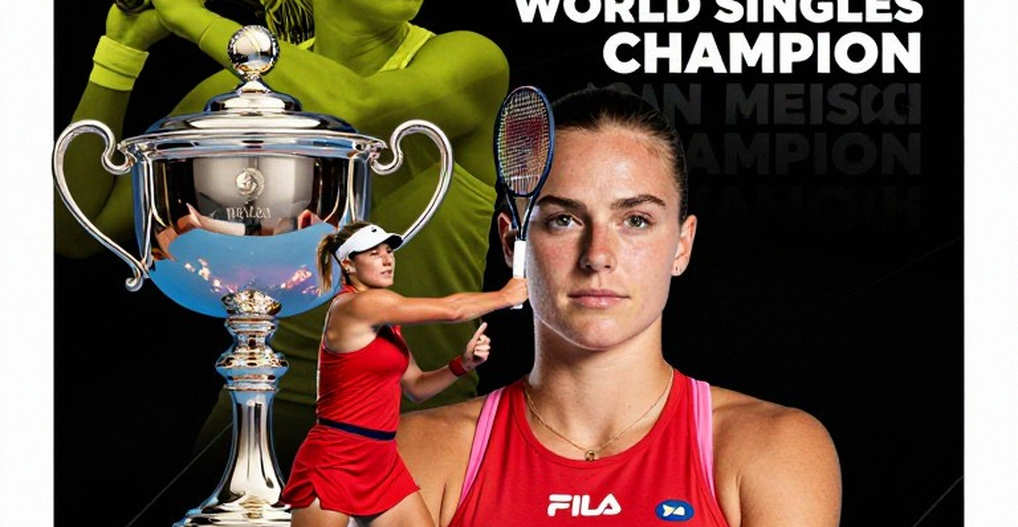
The traditional left-hander's edge rests on one thing: the slice serve to the ad court and the forehand into a right-hander's backhand. When both players are left-handed, that edge is cancelled simultaneously for both. The match then falls back on raw power and return quality, and there the bigger hitter — Shnaider, here — takes the early advantage. My spreadsheet for this final runs to fourteen rows; three of them explain how it turned.
Row one: three break points against Shnaider's serve at 1-1 in the decider, all three saved. Saving three break points is in itself a sequence that flips a set. Immediately after saving them she broke in the fifth game and then closed with three straight games. The heaviest number in this win is not a serve statistic but break-point defence.
Row two: 2 hours 18 minutes across a 30-game match. That is long relative to the game count, and the length is not coincidence. For a rally-extender like Fernandez there was exactly one route to converting a firepower deficit into a contest — make the points longer. She did it: coming back from 6-4, 4-0 down to force a decider was not just fight, it was a rally plan working.
Row three: Fernandez's structural ceiling is her serve. Against an elite returner it does not offer free points, and when a match comes down to break points that is precisely the gap that decides it. Failing to convert any of three break points at 1-1 is the cleanest proof of that ceiling — a conversion problem, not a fitness or movement problem.
And the fourth point, the uncomfortable one: Shnaider's weakness is not in hitting, it is in closing. The road from 4-0 to 5-7 was not technical, it was game management drifting. The shot-making held; the decisions slipped. Winning one of eight games in a mid-match stretch is a pattern that a smart opponent will treat as repeatable damage, because repeating it requires nothing new.
One honest caveat is required: this match's first-serve percentage, return points, winner-to-error ratio — none of it is public. What is available is the score, the duration and the break-point sequence. The conclusions above follow from those three things; anything beyond that would be inference, and inference does not go in the ledger.
The tour sold the result as 'SUPER SHNAIDER', and the tag is understandable — a 22-year-old, a sixth title, the first of the season. An outside reader will take it as a top-10 announcement. I read it differently.
Winning a 500-level title in early November is one thing; treating that title as proof of a year's work is another. A season's first title arriving in November is itself a statement, and not a flattering one. Add the fact that the field was thin in the top eight's absence, and the fact that the win contains seven losses in eight games in the middle. This title is a confirmation of existing ground, not the opening of a new ceiling. Six titles at 22 is excellent — but it is a guarantee of 500-level conversion, not of Slams or 1000s. My guess is that if Shnaider is not top-10 a year from now, the reason will not be this Tokyo win but this Tokyo second set.
On the other side, reading Fernandez's defeat as decline would be equally wrong. Coming back from 6-4, 4-0 down to force a decider shows a high competitive floor. Her limit lies in converting break points against big hitters, not anywhere else — and that limit is repaired through return-game planning, not tape and physio.
The next hard-court swing will test the pattern. If the 4-0-to-5-7 sequence returns, it will charge its price in seeding-critical quarterfinals and semifinals. I follow the pattern until the pattern admits where it was built. The scoreboard is the last draft of a story the tempo wrote earlier. The question is when Shnaider will read that draft.